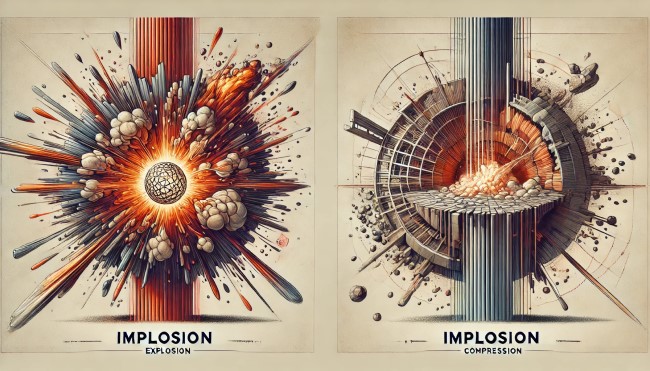
When it comes to powerful forces in physics, engineering, and even nature, the concepts of implosion vs explosion often come up. While both involve rapid energy release and dramatic effects, they differ fundamentally in mechanism, outcomes, and applications. Understanding these differences is crucial, whether you are studying scientific phenomena, construction demolition, or even astrophysics. This article dives deep into the world of implosion vs explosion, exploring their definitions, principles, examples, and practical implications.
| Aspect | Implosion | Explosion |
|---|
| Definition | Collapse inward due to external pressure exceeding internal pressure | Sudden outward release of energy, gases, heat, and pressure |
| Direction of Force | Inward | Outward |
| Energy Release | Absorbed inward, minimal external damage if controlled | Expelled outward, can cause significant damage |
| Examples in Daily Life | Controlled building demolition, vacuum-sealed containers, submarine crush under deep-sea pressure | Fireworks, gas explosions, volcanic eruptions, chemical reactions |
| Examples in Science & Technology | Nuclear implosion for bomb design, lithotripsy in medicine, star collapse (neutron stars, black holes) | Combustion engines, supernovae, gas detonations |
| Key Characteristics | Controlled collapse, precision needed, inward compression | Rapid expansion, heat, light, shockwaves, high outward pressure |
| Safety Considerations | Safer if controlled, catastrophic if unplanned | Generally dangerous due to outward energy spread, requires strict safety measures |
| Significance | Engineering, astrophysics, medical applications | Chemistry, physics, energy release, demolition, weaponry |
| Famous Examples | Demolition of large skyscrapers, implosion of submarines under deep-sea pressure | Hiroshima & Nagasaki bombs (historical nuclear explosions), Mount Vesuvius eruption |
What is an Explosion?
An explosion is a sudden, violent release of energy, often accompanied by rapid expansion of gases, heat, light, and pressure waves. Explosions can occur naturally, such as in volcanic eruptions or meteor impacts, or artificially, like in controlled demolitions, fireworks, or chemical reactions.
The key characteristics of an explosion include:
-
Rapid outward expansion – The energy moves away from the source in all directions.
-
High pressure and shockwaves – The force produced can cause significant damage to nearby objects or structures.
-
Heat and sound – Many explosions produce flames, high temperatures, and loud noises.
In essence, an explosion is about pushing energy outwards violently, often resulting in destruction.
What is an Implosion?
An implosion, in contrast, involves the inward collapse of an object or structure due to external pressure exceeding internal pressure. Instead of energy exploding outward, it is as if the surrounding forces “squeeze” the object inwards until it collapses.
Key features of an implosion include:
-
Inward force – Pressure from the outside causes the object to collapse inward.
-
Controlled collapse – Implosions are often carefully designed, especially in building demolitions.
-
Minimal outward debris – Since energy is directed inward, the surrounding area is often safer compared to explosions.
In short, an implosion is about pulling inward, compressing, and collapsing, rather than forcefully expanding.
The Physics Behind Implosion vs Explosion
The difference between implosion vs explosion is primarily rooted in physics. Explosions occur when the internal energy of a substance is greater than the surrounding pressure, forcing it outward. For instance, a pressurized gas cylinder that ruptures releases energy outward violently.
Implosions, on the other hand, happen when the external pressure overwhelms the internal pressure, causing inward collapse. A classic example is a submarine being crushed under deep ocean pressure, where the surrounding water pressure exceeds the structural integrity of the vessel.
The underlying physics can be summarized as:
-
Explosion: Energy moves from high internal pressure to lower external pressure.
-
Implosion: External pressure exceeds internal pressure, causing inward collapse.
Examples in Daily Life and Nature
Explosions
Explosions are everywhere in our world, both naturally and artificially. Some common examples include:
-
Fireworks – Chemical reactions produce heat, light, and a rapid outward force.
-
Volcanoes – Magma, gas, and pressure cause violent eruptions.
-
Gas leaks – Accumulated gas in confined spaces can explode when ignited.
Implosions
Implosions are less commonly observed but equally fascinating. Examples include:
-
Controlled building demolition – Engineers use timed explosives to collapse a building inward safely.
-
Vacuum-sealed containers – If the container is not strong enough, it may implode under external atmospheric pressure.
-
Astrophysics – Stars can undergo gravitational implosion during the formation of black holes or neutron stars.
Controlled Demolition: Implosion vs Explosion in Practice
In construction, the difference between implosion vs explosion is highly significant. Explosions in demolition are chaotic and dangerous, often scattering debris in all directions. Implosions, by contrast, are carefully planned to make a building collapse inward, minimizing risk to surrounding areas.
Engineers studying implosions use precise calculations for:
-
Placement of explosives
-
Timing sequences
-
Structural weaknesses
By leveraging the inward collapse of structures, implosions ensure safety while achieving the goal of demolition efficiently.
Implosion vs Explosion in Science and Technology
The concepts of implosion vs explosion extend far beyond construction. They are central to multiple scientific and technological fields:
-
Nuclear physics: Nuclear weapons involve both explosive and implosive designs. For instance, some nuclear devices use implosion to compress fissile material to reach critical mass.
-
Medical technology: Techniques like lithotripsy use focused implosive energy to break kidney stones.
-
Astrophysics: Supernovae are examples where explosive forces release energy outward, whereas black hole formation involves gravitational implosion.
Understanding these mechanisms helps scientists manipulate energy for practical and experimental purposes safely.
Safety Considerations: Why the Difference Matters
Recognizing the difference between implosion vs explosion is vital for safety. Explosions are inherently more dangerous because energy is released outward, threatening people and structures in the vicinity. Implosions, when properly controlled, contain most of the force inward, reducing risk.
However, uncontrolled implosions can be deadly, such as when deep-sea vessels fail or structures collapse unexpectedly. Both phenomena require careful planning, risk assessment, and adherence to safety protocols.
Key Takeaways: Implosion vs Explosion
To summarize the main points of implosion vs explosion:
| Feature | Explosion | Implosion |
|---|---|---|
| Direction of force | Outward | Inward |
| Energy release | Rapid and expansive | Collapsing inward |
| Typical examples | Fireworks, gas explosions, volcanic eruptions | Building demolitions, submarines under pressure, star collapse |
| Safety concerns | High risk to surroundings | Safer if controlled, but catastrophic if uncontrolled |
| Scientific relevance | Combustion, nuclear reactions, chemistry | Engineering, astrophysics, medical technology |
Frequently Asked Questions (FAQs) on Implosion vs Explosion
Q1: Can explosions turn into implosions?
A: Typically, no. Explosions and implosions are defined by the direction of energy release. However, complex systems, like nuclear devices, may use controlled implosions to trigger an explosive reaction.
Q2: Which is more dangerous, implosion or explosion?
A: Generally, explosions are more dangerous because energy spreads outward. Implosions can be catastrophic if uncontrolled, but they are often safer when engineered.
Q3: Are implosions common in nature?
A: Implosions are less visible in daily life but are common in extreme environments, such as deep oceans or astrophysical events like star collapse.
Q4: How are controlled implosions achieved in buildings?
A: Engineers strategically place explosives along weak points and use timed sequences to collapse the structure inward safely.
Conclusion: Understanding Implosion vs Explosion
The concepts of implosion vs explosion may seem similar on the surface, but they are fundamentally different in terms of direction, energy dynamics, and applications. Explosions push energy outward violently, while implosions collapse inward under external pressure. Both phenomena are integral to scientific research, engineering, natural events, and even medical technologies.